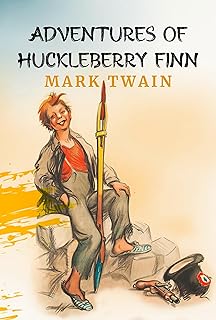
When discussing the great American novel, few titles carry the weight and enduring controversy of Mark Twain's Adventures of Huckleberry Finn. Published in 1884 in the United Kingdom and 1885 in the United States, this book is far more than a simple sequel to The Adventures of Tom Sawyer. It is a profound, satirical, and deeply human journey down the Mississippi River that holds a mirror to the soul of a nation. For modern readers seeking an accessible entry point into this classic, the Dover Thrift Editions: Classic Novels version offers an affordable and faithful reproduction of Twain's original text, making this essential story available to all.
This article delves into the reasons why Huckleberry Finn remains not just a staple of academic syllabi but a vital, living piece of literature. We will explore its groundbreaking narrative voice, its unflinching social satire, its complex treatment of race and freedom, and its status as the quintessential American coming-of-age story. Understanding this novel is key to understanding a significant portion of the American literary canon and the nation's ongoing dialogue about its own history.
The Unforgettable Voice of Huckleberry Finn
One of the novel's most revolutionary achievements is its first-person narration through the voice of Huck himself. Twain abandoned the formal, literary English of his era to write in the authentic vernacular of a poor, uneducated boy from the American South. This was a bold artistic choice that immediately immersed the reader in Huck's world and perspective. Phrases like "I reckon" and "it was awful thoughts and awful words, but they was said" create an intimacy and realism that was unprecedented in American literature at the time.
This voice does more than establish character; it becomes the vehicle for the novel's satire and moral complexity. Because Huck narrates events with naive honesty, the hypocrisy and cruelty of the "sivilized" world around him are exposed with devastating clarity. The reader sees the absurdity of feuds, the greed of fraudsters like the King and the Duke, and the brutality of slavery through the clear, unjaded eyes of a child. This narrative technique allows Twain to critique society without ever sounding preachy, as the criticism emanates naturally from Huck's lived experience.
A Scathing Satire of Antebellum Society
Mark Twain was a master satirist, and Huckleberry Finn is perhaps his finest work in this regard. The novel functions as a panoramic satire of the social institutions and attitudes of the pre-Civil War American South. Through Huck's journey, Twain lampoons everything from romanticized notions of chivalry and honor (the Grangerford-Shepherdson feud) to religious hypocrisy (the praying slave-owning families) and the corrupting nature of greed (the endless schemes of the King and the Duke).
This satirical edge is what elevates the story from a simple adventure tale to a work of significant American literature. Twain holds up a distorted yet recognizable reflection of society, forcing his contemporaries—and modern readers—to confront its flaws. The Dover Thrift Editions ensure that this powerful satire, presented in its original form, remains in print and accessible, preserving Twain's biting commentary for new generations. The edition is part of a series dedicated to keeping classic novels affordable and in circulation.
The Central Relationship: Huck and Jim
At its heart, the novel is the story of a transformative friendship between a runaway boy and a runaway slave, Jim. This relationship is the moral core of the book and the source of its greatest tension and power. Initially, Huck sees Jim through the lens of the racist society that raised him. He participates in crude jokes and struggles with the idea of helping "steal" another man's "property."
Huck's famous crisis of conscience—"All right, then, I'll go to hell"—marks one of the most pivotal moments in American literature. In choosing to help Jim escape rather than turn him in, Huck rejects the laws and morals of his society in favor of his own lived experience and human connection. He chooses friendship and what he feels in his "heart" is right over the dictates of a corrupt "conscience" shaped by a slaveholding culture. This journey from societal indoctrination to individual moral reckoning is the essence of Huck's coming-of-age story.
Confronting America's Original Sin: Race and Slavery
It is impossible to discuss Huckleberry Finn without addressing its complex and often contentious portrayal of race. The novel is set in a slave state roughly two decades before the Civil War, and Twain does not shy away from depicting the reality of that world, including the use of racially charged language. This has made the book a frequent target for censorship attempts, though many scholars argue that to remove the offensive language is to sanitize history and dilute the novel's anti-slavery message.
Twain's portrayal of Jim is multifaceted. While some early scenes rely on minstrel-style stereotypes, Jim emerges as the novel's most noble, compassionate, and morally sound adult character. He is a loving father, a loyal friend, and a complex human being yearning for freedom. The book's power lies in showing how Huck, through direct interaction, comes to see Jim's full humanity, challenging the dehumanizing ideology of slavery. Reading this dynamic in an unadulterated version, like the one provided by Dover Publications, is crucial for engaging with the text's historical and moral weight.
Why the Dover Thrift Edition is an Ideal Choice
For students, book clubs, or any reader encountering this Mark Twain classic for the first or fiftieth time, the Dover Thrift Edition presents distinct advantages. Its primary mission is affordability, breaking down the cost barrier that can prevent people from exploring great literature. Furthermore, Dover is committed to presenting complete, unabridged texts. You are getting Twain's original novel as he wrote it, which is essential for a work where language and dialect are central to its artistic and thematic impact.
While it may lack the extensive footnotes and critical essays of a scholarly edition, the Dover Thrift Edition's simplicity is its strength. It delivers the raw, powerful story directly to the reader, allowing Twain's voice and Huck's narrative to speak for themselves without intermediary interpretation. It is a perfect volume for pure, immersive reading.
The Enduring Legacy of a Literary Landmark
The influence of Adventures of Huckleberry Finn is immeasurable. Ernest Hemingway famously claimed, "All modern American literature comes from one book by Mark Twain called Huckleberry Finn." Writers from William Faulkner to J.D. Salinger and Toni Morrison have acknowledged its impact. It pioneered the use of vernacular speech, deepened the potential of the novel as a tool for social criticism, and presented a uniquely American archetype: the outsider navigating a vast, often hypocritical landscape in search of freedom.
Its themes of moral growth, social hypocrisy, and the quest for liberty are perpetually relevant. The questions Huck grapples with—about right and wrong, law and conscience, society and the individual—are questions every generation must ask itself. This is why the novel continues to be taught, debated, and, most importantly, read.
Conclusion: A Journey Worth Taking
The Adventures of Huckleberry Finn is more than a satire novel or a period piece. It is a foundational text that captures the contradictions of the American experience. It is funny, thrilling, disturbing, and profoundly moving. Huck's journey down the river is a journey into the heart of America's past and its enduring struggles.
To experience this landmark work in a trusted, accessible format, consider the Dover Thrift Editions version of Adventures of Huckleberry Finn. It offers a direct path into the world of the Mississippi, into the mind of one of literature's most memorable narrators, and into a conversation about freedom, friendship, and conscience that is as urgent today as it was in 1885. Embark on Huck's raft; the journey will challenge and change your perspective.