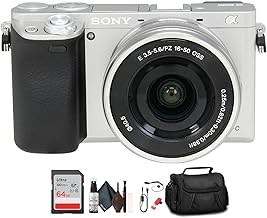
In the ever-evolving world of digital photography, where new models are released with dizzying frequency, it's rare for a camera to maintain its relevance for nearly a decade. Yet, the Sony Alpha a6000 continues to be a hot topic among photography enthusiasts and beginners alike. Launched in 2014, this compact powerhouse redefined what an entry-level mirrorless camera could do. But in 2024, with so many advanced options available, does the Sony A6000 still deserve a spot in your camera bag? This comprehensive review dives deep into its features, performance, and enduring value to help you decide.
Unpacking the Sony A6000: Design and Build Quality
Right out of the box, the Sony A6000 impresses with its compact and lightweight design. Weighing in at just 344 grams (body only), it's a true compact digital camera that won't weigh you down during long shoots or travels. The body, primarily constructed from a high-quality polycarbonate, feels sturdy and well-assembled. It features a comfortable, textured grip that provides a secure hold, which is crucial for a camera in this class. The control layout is intuitive, with a mode dial on top, a customizable rear dial, and several function buttons that can be assigned to your most-used settings. For beginners transitioning from smartphone photography, the learning curve is manageable, while more experienced users will appreciate the direct access to key controls.
The Heart of the Camera: 24.3MP APS-C Sensor and Image Quality
At the core of the Sony A6000 is a 24.3-megapixel APS-C Exmor APS HD CMOS sensor. This sensor size is larger than those found in typical point-and-shoot cameras and even most smartphones, which translates directly to better image quality, especially in low light. The 24.3MP resolution is more than sufficient for large prints, detailed cropping, and sharing on social media. In good lighting conditions, the camera produces images with excellent detail, vibrant colors, and a pleasing dynamic range. The JPEG engine does a commendable job straight out of the camera, but shooting in RAW format unlocks the full potential of the sensor, giving you immense flexibility in post-processing to correct exposure or white balance.
Speed Demon: The Legendary Fast Hybrid AF System
Perhaps the most celebrated feature of the Sony A6000 is its autofocus system. For its time—and even now—it was groundbreaking. The camera employs a Fast Hybrid AF system that combines 179 phase-detection points (which cover about 92% of the frame) with 25 contrast-detection areas. This combination results in what can only be described as a fast autofocus camera. It locks onto subjects with remarkable speed and accuracy, making it exceptionally capable for capturing action, pets, or children. The real-world performance is where it shines; it can track a moving subject across the frame with impressive consistency, a feature that was uncommon in this price bracket when it launched and remains highly competitive today.
Versatility with the Sony E-Mount Ecosystem
The camera comes bundled with the versatile Sony E PZ 16-50mm f/3.5-5.6 OSS power zoom lens. This kit lens is incredibly compact when retracted, making the whole package pocketable in a jacket. Its optical stabilization (OSS) helps achieve sharper handheld shots at slower shutter speeds. The true power of the Sony E-mount lens system, however, lies in its expandability. The E-mount is one of the most extensive and future-proof lens systems available, with options ranging from affordable primes to professional-grade G Master zooms. Whether you want a fast 35mm f/1.8 for portraits, a wide-angle lens for landscapes, or a telephoto for wildlife, the ecosystem has you covered, making the A6000 a camera you can grow with.
Performance for Travel and Everyday Photography
For travel photographers and hobbyists, the Sony A6000 hits a sweet spot. Its small size makes it an ideal travel photography camera, easily fitting into a day bag. The battery life, rated at about 360 shots per charge (CIPA standard), is adequate for a day of casual shooting, though carrying a spare is recommended for heavy use. The 3.0-inch tilting LCD screen is bright and useful for composing shots from high or low angles, though it's not a touchscreen—a feature common in newer models. The electronic viewfinder (EVF) is a significant advantage over entry-level DSLRs, offering a 100% field of view and a real-time preview of your exposure settings.
Sony A6000 in 2024: Addressing Common Questions and Considerations
Many potential buyers wonder if a 10-year-old camera can keep up. For still photography, the answer is a resounding yes. The image quality from its 24.3MP sensor is excellent and holds up against many modern competitors. Its autofocus speed is still class-leading for its price. However, it's important to note its limitations: video capabilities are limited to 1080p Full HD (not 4K), and it lacks features like in-body image stabilization (IBIS) and a microphone jack, which are important for serious videographers. For a photographer focused primarily on stills, especially as a best beginner mirrorless camera, these shortcomings are easy to overlook given the incredible value.
Who Should Buy the Sony Alpha a6000 in 2024?
The Sony A6000 is not a jack-of-all-trades for professionals, but it remains a master of several key areas for specific users. It is the perfect candidate for: Photography Beginners who want to learn manual controls without a huge financial investment. Travelers and Street Photographers who prioritize a lightweight, high-quality kit. DSLR Users Looking to Downsize who want mirrorless benefits without sacrificing performance. Parents who need a fast camera to capture fleeting moments of their kids. If your primary needs are stellar still image quality, portability, and fast autofocus for a budget-friendly price, the A6000's legacy is well-deserved.
Final Verdict: An Enduring Classic
Reviewing the Alpha a6000 in 2024 is an exercise in recognizing timeless engineering. While it may lack the latest bells and whistles like 4K video or a fully articulating screen, its core photographic competencies—the excellent 24.3MP sensor, the blisteringly fast and accurate autofocus, and the compact form factor—are as relevant today as they were at launch. It represents one of the best values in the used and refurbished camera market, offering performance that punches far above its current price point. For anyone entering the world of interchangeable lens cameras, the Sony A6000 isn't just a historical footnote; it's a proven, capable, and highly rewarding tool that continues to empower photographers to create beautiful images.