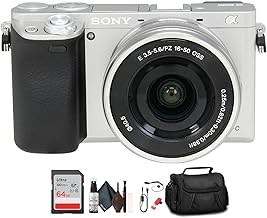
For years, the Sony A6000 has been the undisputed champion for photographers and vloggers entering the mirrorless world. Its blend of performance, portability, and price created a legacy that endures. But technology marches on, and Sony introduced the Alpha A6100 as a direct successor. If you're holding an A6000 or choosing your first camera, the decision between these two can be confusing. Is the newer model a must-have upgrade, or does the classic still hold its ground? This in-depth comparison breaks down the key differences in autofocus, video capabilities, design, and overall value to help you make the right choice for your photography journey.
The Core Legacy: Understanding the Sony A6000's Enduring Appeal
The Sony A6000 wasn't just a camera; it was a phenomenon. Launched in 2014, it packed a 24.3MP APS-C sensor and a blistering 11 fps continuous shooting speed into a tiny body, challenging larger DSLRs. For travel photography, its compact size was revolutionary. It proved that a beginner camera could offer professional-grade image quality. Its hybrid autofocus system, with 179 phase-detection points, was groundbreaking for its time and remains competent for general photography and casual action shots. The vast ecosystem of Sony E-mount lenses, from affordable primes to high-end zooms, cemented its position. Even today, its value proposition on the used or renewed market is incredibly strong, making it a compelling entry point for those on a strict budget who prioritize stills over advanced video features.
The Modern Contender: What the Alpha A6100 Brings to the Table
The Alpha A6100 represents Sony's refined vision for the entry-level mirrorless camera segment. It inherits the beloved compact form factor but injects it with a massive technological leap, primarily in two areas: autofocus and video. At its heart is a newer 24.2MP APS-C sensor paired with Sony's latest BIONZ X image processor. This combination unlocks the camera's most significant advantage: Real-time Eye AF and Real-time Tracking. Borrowed from Sony's professional lineup, this system uses artificial intelligence to lock onto and track a subject's eye with frightening accuracy, even when they are turned away. This makes it an unparalleled tool for portrait photographers, parents capturing kids, and anyone shooting unpredictable subjects.
Head-to-Head: Key Differences That Matter
Autofocus & Performance: A Generational Leap
This is the most dramatic difference. The A6000's 179-point hybrid AF system is good, but the A6100's 425-point phase-detection system with Real-time Tracking is in another league. For still photography, the A6100 will achieve a much higher keeper rate for moving subjects. For video, this translates to smooth, reliable focus pulls that stick to your subject's face, a game-changer for solo creators and vloggers. The A6100 also introduces Animal Eye AF, a boon for pet photographers. If your work involves any kind of motion or portraiture, the A6100's autofocus capabilities are a compelling reason to upgrade.
Video Capabilities: From Basic to Vlog-Ready
The Sony A6000 shoots 1080p Full HD video, which is still perfectly usable. However, the Alpha A6100 elevates the game significantly for content creators. It offers 4K UHD video recording without pixel binning, resulting in sharper, more detailed footage. Crucially, it includes a microphone input jack, allowing you to connect an external mic for clear, professional-grade audio—a fundamental requirement for serious vlogging camera use. The A6100 also features a 180-degree flip-up LCD screen, making it easy to frame yourself while recording. For anyone whose needs have shifted towards video content creation, the A6100 is the clear and necessary choice.
Design & User Experience: Subtle Refinements
Physically, the cameras are very similar. Both are lightweight APS-C cameras ideal for all-day carry. The A6100 offers a slightly improved grip and a more responsive touchscreen interface (though touch-to-focus is the primary function). The electronic viewfinder and rear screen resolution are similar. The menu system on the A6100 is marginally more organized but still carries Sony's classic complexity. For a user familiar with the A6000, transitioning to the A6100 would be seamless.
Who Should Choose Which Camera?
Stick with (or Buy) the Sony A6000 if:
- Your budget is your primary constraint: You can find excellent used or renewed A6000 kits at a fraction of the cost of a new A6100.
- You are 100% focused on still photography: If you rarely shoot video and don't need cutting-edge subject tracking for fast action, the A6000's image quality remains superb.
- You're a complete beginner testing the waters: It's a lower-risk investment to learn the basics of photography and the Sony system.
Upgrade to (or Start with) the Alpha A6100 if:
- You shoot video for YouTube, vlogs, or social media: The 4K, mic input, and flip screen are non-negotiable features for modern content creation.
- You photograph people, pets, or anything that moves: Real-time Eye AF (Human and Animal) is a transformative technology that will improve your work instantly.
- You want a camera that feels future-proof: The autofocus and video specs align the A6100 with much more expensive cameras, giving you room to grow without needing a new body.
- You're a hybrid shooter: If your needs are split between high-quality photos and capable video, the A6100 is the balanced, do-it-all tool.
Verdict: Evolution, Not Revolution
The Sony A6000 deserves its legendary status. It is a testament to how a well-designed product can dominate a market for years. For the budget-conscious stills photographer, it remains a brilliant and valid choice. However, the Alpha A6100 is the logical evolution, addressing the core limitations of its predecessor for the modern creator. Its autofocus isn't just better; it's a different category of performance. Its video features aren't an afterthought; they are built for today's content landscape.
Ultimately, your choice hinges on your priorities and budget. If you value absolute cost savings and shoot primarily stills, the A6000's legacy is secure. But if your photography involves motion, your projects include video, or you simply want the most advanced and versatile tool in this compact form factor, the A6100 is the definitive upgrade and the smarter long-term investment. It successfully bridges the gap between a classic beginner camera and a capable, modern hybrid imaging tool.