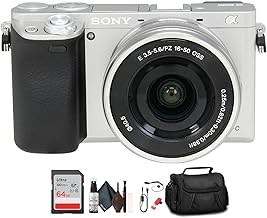
Launched nearly a decade ago, the Sony A6000 has achieved near-mythical status in the world of photography. It was a game-changer that helped solidify Sony's position in the mirrorless market, offering pro-level features at an entry-level price. But in the fast-paced world of camera tech, a decade is a lifetime. The question every potential buyer asks today is simple: Is the Sony A6000 still a good buy in 2024? This comprehensive review dives deep into its performance, features, and real-world usability to help you decide if this classic camera deserves a spot in your bag.
Unboxing the Legend: First Impressions & Build Quality
Picking up the Sony A6000, its compact and lightweight design is immediately apparent. Compared to modern counterparts, its polycarbonate body feels solid but not overly premium. The grip is surprisingly deep and comfortable for a camera of its size, allowing for secure one-handed operation. The control layout is classic Sony, with a mode dial on top, a rear command dial, and a customizable function (Fn) button. While it lacks the touchscreen and more advanced controls of newer models, the physical buttons are well-placed and offer good tactile feedback. For photographers transitioning from a smartphone or a basic point-and-shoot, the Sony A6000 provides a perfect bridge into more manual control without being overwhelming.
Under the Hood: Sensor, Autofocus, and Performance
The 24.3MP APS-C Sensor
At the heart of the A6000 is a 24.3-megapixel APS-C Exmor CMOS sensor, paired with Sony's BIONZ X image processor. This combo was revolutionary in 2014 and remains highly capable today. The sensor delivers excellent detail, dynamic range, and color reproduction. In good light, images are crisp, with natural colors and manageable noise. While high-ISO performance (above 3200) can't match the latest sensors, results up to ISO 6400 are perfectly usable for web sharing and modest prints. For most daylight, portrait, and landscape photography, this sensor is more than sufficient.
Hybrid Autofocus System: Still Fast and Furious
This is where the A6000 truly made its mark. Its 179-point phase-detection AF and 25-point contrast-detection AF system promised DSLR-like speed. In practice, it still delivers. Single-shot AF is lightning-fast and accurate, making it excellent for portraits and still life. Continuous autofocus (AF-C) with tracking, especially for moving subjects like pets or active children, is impressive for its age, though it can struggle with more erratic, fast-paced sports compared to Sony's latest Real-time Tracking tech. Eye AF was introduced in later firmware but is a basic version; it works but isn't as sticky or reliable as in newer Alpha cameras.
In the Field: Shooting Experience and Image Quality
Using the Sony A6000 is a joy for enthusiasts who enjoy the process. The electronic viewfinder (EVF) is a 1.44-million-dot unit. It's not the brightest or highest-resolution by today's standards, but it provides a clear, real-time preview of your exposure—a crucial advantage over optical viewfinders for learners. The 3-inch tilting LCD screen is fixed, not articulating, and lacks touch functionality. This limits its usefulness for vlogging or shooting from awkward angles but is fine for standard photography.
Image quality is the A6000's strongest suit. JPEGs straight out of the camera are pleasing, with accurate white balance and vibrant colors. For those who want more control, shooting in RAW provides immense flexibility in post-processing, allowing you to recover shadows and highlights effectively. The camera's metering system is generally reliable, though it can be tricked by high-contrast scenes, a common trait in many cameras.
Video Capabilities: A Look at the Past
If video is a primary concern, the A6000 shows its age. It maxes out at Full HD 1080p at 60fps (in a lower-quality AVCHD format) or 24/30fps in MP4. It lacks 4K video, log profiles, and advanced audio inputs. The autofocus during video is contrast-detect only, meaning it can be slower and hunt more than during stills. For casual family videos or simple YouTube content in good light, it's acceptable. However, for any serious videography or vlogging, modern smartphones or newer cameras like the Sony ZV-E10 are far better equipped.
Battery Life and Lens Ecosystem
The NP-FW50 battery is the A6000's Achilles' heel. Sony's official rating is around 360 shots per charge, but real-world use with the EVF and frequent chimping often yields less. Carrying a spare battery (or two) is non-negotiable for a full day of shooting. On the bright side, the camera benefits immensely from Sony's expansive E-mount lens ecosystem. You can pair it with everything from affordable kit lenses to premium G Master glass. Popular choices include the Sigma 30mm f/1.4 for portraits or the Sony 18-135mm for a versatile travel zoom. The lens you choose will dramatically impact the camera's performance more than the body itself.
Sony A6000 vs. The Competition: What Are Your Options?
When considering the A6000 today, you're likely looking at the used or refurbished market, where it can be found for a very attractive price. It's essential to compare it to other options in a similar budget:
- Newer Sony Models (A6100, A6400): These offer significant upgrades: a flip-up touchscreen, vastly improved Real-time Eye AF and tracking, 4K video, and better battery life. If your budget stretches, they are better long-term investments.
- Modern Smartphones: For casual snapshots and social media, modern smartphones offer computational photography magic (Night Mode, HDR) that the A6000 can't match, especially in low light. However, the A6000 provides superior optical zoom (with lenses), background blur (bokeh), and manual creative control.
- Other Entry-Level Mirrorless: Cameras like the Canon EOS M50 Mark II or Fujifilm X-T200 offer more modern features like fully articulating screens and better video but may trade blows in pure stills autofocus speed.
Who Should (and Shouldn't) Buy the Sony A6000 in 2024?
Buy the Sony A6000 if:
- You're a photography beginner on a tight budget wanting to learn manual controls.
- You need a capable, lightweight second camera body.
- Your primary focus is still photography (portraits, street, travel) in decent light.
- You want access to Sony's excellent E-mount lens system without breaking the bank on the body.
Avoid the Sony A6000 if:
- Video creation or vlogging is a priority.
- You frequently shoot fast-action sports or wildlife.
- You demand the latest autofocus features (like animal Eye AF) or a touchscreen interface.
- You shoot extensively in very low-light conditions and need top-tier high-ISO performance.
Final Verdict: A Timeless Tool for Learning Photographers
The Sony A6000 is no longer the cutting-edge champion it once was. It has clear limitations in video, battery life, and some modern conveniences. However, as a tool for learning the fundamentals of photography—aperture, shutter speed, ISO, and composition—it remains an outstanding value. Its image quality for stills is still excellent, its autofocus is respectably fast, and its compact form factor is timeless. If you can find one in good condition at a low price, and your needs align with its strengths, the Sony A6000 is a classic that can absolutely help you create beautiful images and develop your skills. It's a testament to great design that a camera from 2014 can still be a relevant and powerful creative tool today.