Surrounded by Idiots Revised & Expanded Edition: The Four Types of Human Behavior and How to Effectively Communicate with Each in Business (and in Life)
Product Description
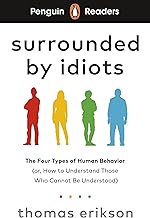
The Surrounded by Idiots Revised & Expanded Edition by Thomas Erikson is a groundbreaking guide to understanding human behavior. Based on the widely recognized DISC model, it categorizes people into four distinct color types: Reds (dominant), Yellows (inspiring), Greens (stable), and Blues (analytical). This book provides a powerful framework for decoding why people act the way they do, moving beyond frustration to effective interaction. It's more than just a personality test; it's a practical toolkit for navigating the complex social landscapes of the modern workplace and personal life.
This expanded edition delves deeper into practical applications, offering specific strategies for communicating, motivating, and collaborating with each behavior type. Whether you're dealing with a demanding boss (likely a Red), trying to inspire a hesitant team (perhaps Greens), or presenting data to a detail-oriented colleague (a classic Blue), this book provides actionable advice. It transforms perceived "idiocy" into understandable patterns of behavior, empowering you to adjust your approach for dramatically better results in meetings, negotiations, and everyday conversations.
Ideal for managers, team leaders, sales professionals, and anyone seeking to improve their interpersonal skills, Surrounded by Idiots translates psychological insights into real-world tactics. By learning to identify the color types around you—and understanding your own—you can reduce conflict, increase productivity, and build stronger, more respectful relationships both in business communication and at home.
Check Best Price & CouponsRelated Products


Reviews
Framework for Understanding, Not Judgment
The primary strength of Surrounded by Idiots is its accessible and memorable framework. The four-color system (Red, Yellow, Green, Blue) is easy to grasp and apply immediately. Unlike complex psychological texts, Erikson presents the human behavior types in a relatable, often humorous way, making the content stick. This model provides a constructive lens through which to view conflicts, shifting the perspective from "this person is difficult" to "this person has a Blue communication style, so I need to provide more data." It fosters empathy and strategic thinking over frustration.
Actionable, Practical Communication Strategies
As a bestseller, this book excels in translating theory into practice. Each section is packed with specific dos and don'ts for interacting with each color type. For example, it teaches you how to give feedback to a sensitive Green (privately, gently) versus a results-driven Red (directly, focusing on outcomes). This practicality is why it resonates so strongly with business readers; it offers clear ROI in the form of improved team dynamics, more effective sales pitches tailored to the client's type, and smoother project management.
Enhanced Self-Awareness and Personal Growth
Beyond understanding others, the book prompts valuable self-reflection. By identifying your own dominant color(s), you gain insight into how your behavior is perceived by others. This self-awareness is a critical component of emotional intelligence and leadership development. The revised edition expands on this, helping readers understand their potential blind spots and how their natural style might clash with or complement others, enabling more intentional and effective personal development.
Universal Applicability Across Contexts
The advantage of this system is its versatility. The principles apply just as powerfully in personal relationships and family dynamics as they do in corporate boardrooms. Understanding why a partner (a Yellow) craves social spontaneity while you (a Blue) need a detailed plan can transform a relationship. This cross-context utility greatly increases the book's value and explains its widespread, enduring popularity.
While immensely popular, the D-I-S-C model presented in Surrounded by Idiots has inherent limitations. The primary critique from behavioral science circles is the risk of oversimplification. Categorizing all of humanity into four boxes can lead to stereotyping if applied rigidly. Readers must remember that these are dominant behavioral *tendencies*, not absolute definitions. Individuals are complex and can exhibit traits from different colors depending on context, stress, or environment. Using the model as a strict labeling tool, rather than a flexible guide, can be counterproductive.
The book's provocative title, while memorable, can also frame interactions adversarially—starting from the premise that you are "surrounded by idiots." Although Erikson works to move past this, the initial mindset might hinder the empathetic approach the content ultimately advocates. Some readers may find the tone overly simplistic or the anecdotes too generalized. Furthermore, those already well-versed in advanced psychology or communication models may find the content introductory rather than deeply novel.
Another consideration is the practical application challenge. Consistently analyzing and adapting your communication style in real-time requires conscious effort and practice. In fast-paced or high-stress situations, it can be difficult to pause and identify another person's color type before responding. The book provides the "what" and "why," but mastering the "how" in the moment is a skill developed over time, which may lead to initial frustration for some readers expecting instant transformation.
![Surrounded by Psychopaths: How to Protect Yourself from Being Manipulated and Exploited in Business (and in Life) [The Surrounded by Idiots Series]](https://m.media-amazon.com/images/I/71OlAuo0zzS._AC_UY218_.jpg)

![Surrounded by Bad Bosses (And Lazy Employees): How to Stop Struggling, Start Succeeding, and Deal with Idiots at Work [The Surrounded by Idiots Series]](https://m.media-amazon.com/images/I/71q4xPRCx9L._AC_UY218_.jpg)
Surrounded by Idiots Revised & Expanded Edition is a highly accessible and practical guide that delivers significant value for anyone looking to improve their communication and relationships. Its strength lies in the simple yet powerful four-type framework that makes complex behavioral concepts easy to understand and apply. For managers, team members, salespeople, or individuals seeking better personal connections, it offers a proven toolkit for reducing conflict and increasing effective communication.
Potential buyers should approach it as a flexible guide, not a rigid scientific taxonomy. Be mindful of the risk of oversimplification and use the color types as indicators of preference rather than fixed labels. If you are new to personality or behavioral models, this book is an excellent and engaging starting point. If you are already an expert in DISC or similar systems, the revised content may offer refreshed perspectives but not fundamentally new information. Overall, for its intended purpose—providing a usable framework to navigate human behavior—it remains a compelling and worthwhile read.
Check Best Price & Coupons


![Surrounded by Narcissists: How to Effectively Recognize, Avoid, and Defend Yourself Against Toxic People (and Not Lose Your Mind) [The Surrounded by Idiots Series]](https://m.media-amazon.com/images/I/71OHX1hxNRL._AC_UY218_.jpg)