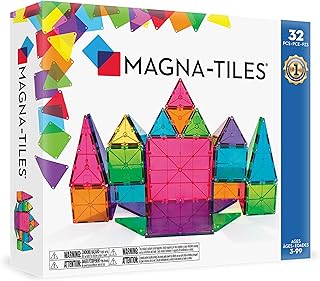
For parents and educators seeking toys that blend fun with foundational learning, few options rival the versatility and engagement of magnetic building tiles. Among these, Magnatiles have earned a reputation as a premier choice, offering a unique combination of open-ended creativity and structured educational value. This comprehensive guide will explore the myriad ways to use these magnetic blocks, from simple preschool structures to complex architectural models, while highlighting their significant role in developing critical STEM skills.
The fundamental appeal of magnetic construction toys lies in their intuitive design. The satisfying click of magnets connecting empowers even young children to build stable, three-dimensional structures that traditional blocks cannot easily achieve. A set like the 100 Piece Set of clear magnetic 3D blocks provides the perfect toolkit for this exploration. The transparent, colorful tiles are not just visually stimulating; they allow builders to see the internal structure of their creations, adding another layer of understanding to spatial reasoning.
Unlocking Creativity: Building Ideas for All Ages
One of the greatest strengths of Magnatiles is their scalability. The play evolves with the child. For toddlers and preschoolers, focus on flat, 2D patterns on the floor or a playboard. Encourage them to create simple shapes—squares, triangles, rectangles—and discuss the colors and forms. This is a fantastic introduction to basic geometry and color recognition. As confidence grows, guide them to turn these 2D shapes into 3D structures. A simple square can become a cube, a triangle can transform into a pyramid. The tactile feedback of the magnets snapping together provides immediate, rewarding success.
For school-age children, the possibilities expand dramatically. Challenge them to build more complex models. Here are some engaging project ideas:
- Architectural Wonders: Skyscrapers, bridges with spans, houses with detailed roofs and windows, and even entire castles with turrets. Discuss concepts of stability, balance, and symmetry during construction.
- Molecular Models: Use the different shapes to represent atoms and bonds, creating simple models of water (H2O) or methane (CH4). This provides a hands-on, visual introduction to basic chemistry.
- Geometric Explorations: Construct all five Platonic solids—tetrahedron, cube, octahedron, dodecahedron, and icosahedron. This advanced project delves deep into the mathematics of polyhedra.
- Maze or Marble Run: Build vertical or horizontal channels and test the path of a small marble. This introduces basic principles of physics and engineering design.
The STEM Powerhouse: Educational Benefits Explained
While the fun is evident, the educational underpinnings of magnetic building tiles are profound. They are a quintessential STEM toy, seamlessly integrating Science, Technology, Engineering, and Mathematics into play.
- Science: Children experientially learn about magnetic polarity (attraction and repulsion) and magnetic force. They explore concepts of gravity and balance as they build taller structures.
- Technology & Engineering: The design process is engineering in its purest form. Kids plan, build, test, and redesign their structures. They learn about structural integrity, load-bearing walls, and the strength of triangular supports versus squares.
- Mathematics: Play is rich with mathematical concepts. Children count pieces, sort by color and shape, recognize patterns and symmetry, and understand geometric principles like area, perimeter, and volume. They engage in spatial reasoning, mentally rotating shapes and understanding how 2D nets become 3D objects.
This hands-on learning is far more effective than rote memorization. When a child sees that a pyramid is more stable than a cube of the same height, they internalize an engineering principle. When they calculate they need 6 squares to build a cube, they grasp a volumetric concept.
Choosing the Right Set and Maximizing Play Value
Starting with a substantial set is key to fostering complex, collaborative play. A 100-piece set provides enough components for multiple children to build together or for a single child to create elaborate, detailed structures without constant limitation. The clear tiles in a set like the one we've mentioned are particularly valuable as they allow light to pass through, creating beautiful stained-glass effects and enabling unique projects like color-mixing explorations.
To maximize the educational and recreational value:
- Play Together: Sit down and build with your child. Narrate your thought process ("I need a stronger base, so I'll use squares here") to model problem-solving.
- Ask Open-Ended Questions: Instead of directing, ask "What do you think will happen if we make the tower taller?" or "How can we make this bridge longer without it falling?"
- Integrate Storytelling: Once a structure is built, invent a story about it. Who lives in the castle? What is the function of the spaceship? This builds narrative and language skills.
- Combine with Other Toys: Use the structures as settings for action figures, dollhouses, or car garages. This extends the play narrative and integrates different types of creative play.
Beyond Play: Long-Term Developmental Impact
The benefits of engaging with educational toys like these extend far beyond the playroom. The skills developed—problem-solving, perseverance, fine motor control, and creative thinking—are foundational for academic success and lifelong learning. Children who engage in this type of constructive play often show greater confidence in tackling math and science problems. They learn that failure (a collapsing tower) is just a step in the iterative process of improvement, fostering a healthy "growth mindset."
In a world saturated with passive screen-based entertainment, Magnatiles offer a compelling, hands-on alternative. They are not just a toy but a dynamic learning platform that grows with your child. From a toddler's first colorful mosaic to a ten-year-old's intricate geometric sculpture, these magnetic tiles provide a universe of possibility, firmly clicking together the building blocks of creativity, logic, and joy.